
Strength Training for Older Adults: Build Muscle, Balance and Independence Without Beating Up Your Joints
Strength training after 50 is not a watered-down version of serious exercise. It is serious training with better risk management. This guide explains how to build muscle, strength, balance and long-term physical capacity with a structured program that can be sustained.
Strength training after 50 is not a diluted version of serious training.
It is serious training with more intelligent risk management.
The objective is not to imitate a twenty-five-year-old athlete, collect impressive gym videos or prove that age has no consequences. Age does influence recovery, injury history, sleep, medical risk and the speed at which some people adapt. Ignoring those realities is not toughness. It is poor programming.
The opposite mistake is equally damaging: treating every person over 55 as fragile.
Many adults in their sixties and seventies are experienced lifters, competitive athletes, coaches, hikers, cyclists, martial artists or physically demanding professionals. Others are returning after years away from training. Some have substantial muscle but declining mobility. Some are lean but weak. Some have excellent cardiovascular fitness but limited upper-body strength. Others are beginning with arthritis, low confidence or a history of falls.
These people do not need the same exercises or starting loads.
They do, however, need the same fundamental system:
- Appropriate resistance.
- Technically controlled movement.
- Progressive overload.
- Adequate recovery.
- Balance and cardiovascular work.
- Nutrition that supports adaptation.
- A plan that can be repeated for years.
The American College of Sports Medicine ranked fitness programs for older adults as the second-largest fitness trend for 2026. Its updated resistance-training position stand also concluded that regular participation is more important for most adults than unnecessarily complicated programming. Resistance training improves strength, muscle size, power and multiple measures of physical performance, including gait speed, balance and stair-related function.
The business case for training is straightforward: physical capacity is an asset. When capacity declines, ordinary tasks consume a greater percentage of what the body can produce. When capacity rises, those same tasks become cheaper.
The goal is not simply to survive aging.
The goal is to maintain enough strength, muscle, balance and movement competence to continue carrying your own life.
Educational and medical boundary
This article provides general education. It is not a medical diagnosis, rehabilitation prescription, treatment plan or individualized training program.
People with unstable cardiovascular disease, uncontrolled blood pressure, recent surgery, recurrent fainting, significant osteoporosis, active cancer treatment, neurological disease, severe balance impairment, uncontrolled diabetes, recent fracture or other complex medical conditions should discuss exercise planning with an appropriately qualified professional.
Stop training and seek urgent medical assessment for chest pain or pressure, fainting, sudden severe shortness of breath, new weakness or numbness, sudden loss of coordination, severe or rapidly worsening pain, substantial trauma, visible deformity or symptoms that do not resemble normal exercise fatigue.
Why strength becomes more important with age
Muscle is infrastructure, not decoration
Muscle is often discussed as if its main purpose were appearance.
That is a shallow view.
Skeletal muscle helps produce force, stabilize joints, absorb force, manage blood glucose, support locomotion and complete daily tasks. It provides the physical reserve required to respond when a task is heavier, faster or less predictable than expected.
Consider two adults carrying the same fifteen-kilogram suitcase.
For the first adult, fifteen kilograms represents 20% of available carrying capacity. The task is inconvenient but routine.
For the second adult, it represents 80% of available capacity. The same suitcase becomes a high-effort event involving altered posture, breath-holding, loss of balance and a greater likelihood of aggravating the back, shoulders or hands.
The suitcase did not change.
The reserve changed.
This principle applies to nearly every daily movement:
- Rising from a low chair.
- Getting off the floor.
- Climbing stairs.
- Carrying groceries.
- Moving luggage.
- Lifting a child.
- Opening a heavy door.
- Walking uphill.
- Catching the body during a stumble.
- Performing physical work around the home.
When strength reserve is high, these activities stay ordinary. When reserve becomes low, routine life begins to operate near maximum capacity.
Strength, muscle mass and power are not identical
A good active-aging program develops more than one quality.
Muscle mass refers to the amount of muscle tissue.
Strength refers to the ability to produce force.
Power refers to the ability to produce force quickly.
Muscular endurance refers to the ability to repeat or sustain force.
Balance refers to controlling the body over its base of support.
Mobility refers to access to usable movement range.
Coordination refers to organizing movement efficiently.
A person may have enough strength to rise slowly from a chair but insufficient power to recover quickly from a trip. Another may have large muscles but poor balance. A third may be flexible but unable to control the available range.
That is why a serious program cannot consist only of stretching, walking or machine circuits. It must address force, control and movement speed in a logical sequence.
ACSM’s 2026 position stand found that resistance training can improve strength, hypertrophy, power, gait speed, balance and broader physical function. It also found that power-oriented resistance training can improve physical function when properly programmed.
Weakness can become a self-reinforcing cycle
Physical decline often follows a predictable sequence:
Lower strength → greater effort during daily tasks → more fatigue or discomfort → less movement → further loss of capacity.
This cycle is not always dramatic. It may begin with small behavioural changes:
- Taking the lift instead of the stairs.
- Avoiding the floor.
- Carrying fewer bags.
- Sitting while completing household tasks.
- Reducing walking speed.
- Declining physically demanding invitations.
- Stopping recreational sport.
- Avoiding the gym because previous weights now feel embarrassing.
These decisions may appear minor, but collectively they reduce exposure to loading, balance and movement practice.
Strength training interrupts that process by creating a controlled environment in which the body can rebuild capacity before daily life demands it unexpectedly.
Age is relevant, but it is not a diagnosis
Chronological age alone does not define training capacity.
A trained sixty-eight-year-old may tolerate substantially more resistance and volume than a sedentary forty-eight-year-old. A seventy-year-old who has lifted for decades may require a more advanced program than a fifty-five-year-old beginner.
Programming should therefore consider:
- Training history.
- Present strength.
- Movement competence.
- Medical history.
- Bone health.
- Medication.
- Joint tolerance.
- Balance.
- Cardiovascular fitness.
- Sleep.
- Nutrition.
- Work and family stress.
- Recent illness or surgery.
- Confidence under load.
The correct starting point is based on current capacity, not assumptions about age.
The objective is not immortality
Strength training does not stop biological aging.
It does not guarantee freedom from illness, injury or disability. It cannot reverse every structural condition or neutralize poor sleep, smoking, severe disease, malnutrition or long-term inactivity.
Its value is more practical.
It gives the body a reason to retain and develop physical capability. It increases the distance between ordinary task demands and maximum capacity. It creates more room for error.
That reserve is one of the most useful assets a person can build.
What current activity guidelines recommend
Public-health recommendations do not prescribe seven punishing workouts or an athlete-level training schedule.
They establish a baseline.
For adults aged 65 and older, CDC guidance calls for aerobic activity, muscle-strengthening work and balance activity every week. The standard target is at least 150 minutes of moderate-intensity aerobic activity, or 75 minutes of vigorous activity, or an equivalent mixture. Muscle-strengthening activity should be performed on at least two days per week and should involve the major muscle groups.
WHO guidance similarly recommends regular aerobic activity, muscle-strengthening work on at least two days per week and multicomponent activity emphasizing functional balance and strength.
The three-part weekly model
| Component | Baseline objective | Practical examples |
|---|---|---|
| Resistance training | At least 2 days weekly | Weights, machines, cables, resistance bands, body-weight exercises |
| Aerobic activity | At least 150 minutes moderate or 75 minutes vigorous weekly | Brisk walking, cycling, swimming, rowing, hiking |
| Balance and multicomponent work | Repeated exposure during the week | Single-leg holds, controlled stepping, heel-to-toe walking, tai chi |
These categories overlap.
A loaded carry develops strength, trunk control, gait and some balance.
A step-up develops leg strength, single-leg control and cardiovascular demand.
Hiking may develop aerobic fitness, balance and lower-body endurance.
The categories do not need to exist in separate boxes. They do need to be present.
A realistic weekly schedule
A sustainable week could look like this:
| Day | Main activity |
|---|---|
| Monday | Full-body strength session A |
| Tuesday | Brisk walk or cycling for 25–40 minutes |
| Wednesday | Short balance practice and easy movement |
| Thursday | Full-body strength session B |
| Friday | Brisk walk or another aerobic activity |
| Saturday | Recreational activity, hiking, swimming, sport or gardening |
| Sunday | Rest or light recovery movement |
This is not the only valid structure.
Someone who enjoys three shorter strength sessions may divide the work differently. An experienced lifter may use an upper/lower split. A person with low capacity may begin with ten-minute sessions.
The operating principle is consistent exposure without creating more fatigue than the body can recover from.
Walking is important, but it is not complete strength training
Walking has substantial value. It can improve aerobic fitness, increase daily energy expenditure, support mood and provide regular low-impact movement.
It usually does not provide sufficient progressive resistance for every major muscle group.
Regular walkers can still have:
- Weak upper-body pushing strength.
- Poor pulling strength.
- Limited grip.
- Inadequate hip strength.
- Difficulty rising from low positions.
- Low trunk capacity.
- Limited ability to carry external loads.
Walking and resistance training should not compete.
They solve different parts of the physical-capacity problem.
Some activity is better than none
The guideline is a destination, not an admission requirement.
Someone currently doing no structured exercise does not need to jump immediately to 150 minutes of aerobic work plus multiple gym sessions.
CDC guidance explicitly recognizes that people who cannot meet the full recommendation should be as active as their abilities and conditions allow.
A person may begin with:
- Two twenty-minute strength sessions.
- Three ten-minute walks.
- Five minutes of balance practice.
- More standing and less uninterrupted sitting.
The first performance objective is not perfection.
It is establishing repeatability.
Start with a risk screen, not a fear screen
Training decisions should be conservative without becoming paralysing.
The purpose of screening is not to create the impression that movement is inherently dangerous. The purpose is to identify cases where generic programming is insufficient.
Green level: begin with conservative training
A generally healthy adult without concerning symptoms can usually begin with low-complexity exercises, manageable loads and gradual progression.
The first few sessions should answer practical questions:
- Which movements feel stable?
- Which ranges are controlled?
- How does the body respond the following day?
- How quickly does breathing recover?
- Does balance deteriorate under fatigue?
- Which joints require modifications?
- How much work can be repeated later in the week?
The first training block is partly assessment.
Yellow level: obtain additional guidance
Professional guidance is prudent when there is uncertainty involving:
- Diagnosed cardiovascular disease.
- Poorly controlled blood pressure.
- Diabetes treated with medication that may cause hypoglycaemia.
- Osteoporosis or fragility-fracture history.
- Recurrent falls.
- Significant neurological disease.
- Recent joint replacement.
- Recent abdominal, cardiac or spinal surgery.
- Active cancer treatment.
- Severe arthritis.
- Persistent or unexplained pain.
- Medication affecting heart rate, blood pressure, coordination or balance.
- A long period of inactivity combined with very low physical capacity.
NIA states that older adults with many chronic conditions can benefit from physical activity, but the activity plan may require adaptation and professional coordination.
Red level: stop self-directing
Seek urgent medical assessment for symptoms such as:
- Chest pain, pressure or unexplained tightness.
- Fainting or near-fainting.
- Sudden severe shortness of breath.
- New one-sided weakness.
- New numbness or loss of coordination.
- Sudden major balance deterioration.
- Severe pain following trauma.
- Visible deformity.
- Sudden confusion.
- Loss of bladder or bowel control.
- Severe or rapidly worsening symptoms.
- Unexplained systemic symptoms combined with pain.
Do not use exercise to test whether a potentially serious symptom will disappear.
Normal exercise effort versus concerning symptoms
Normal training sensations may include:
- Muscular burning near the end of a set.
- Increased breathing.
- Increased heart rate.
- Mild short-term muscle fatigue.
- Temporary stiffness after unfamiliar exercise.
- Mild muscular soreness one or two days later.
More concerning patterns include:
- Sharp or electric pain.
- Pain that spreads down a limb.
- New numbness.
- Sudden weakness.
- Joint instability.
- Dizziness.
- Chest symptoms.
- Severe headache.
- Symptoms that intensify with each repetition.
- Symptoms that continue worsening after the session.
Not every discomfort indicates damage. Not every painful sensation should be ignored.
The correct response is classification, modification and assessment where required.
Build the program around fundamental movement patterns
Exercise selection should begin with function.
A good full-body program normally includes:
- Squat or sit-to-stand.
- Hip hinge.
- Push.
- Pull.
- Step or split-stance movement.
- Carry.
- Trunk control.
- Calf and ankle work.
- Balance.
- Power, when appropriate.
Each category can be trained with multiple tools.
There is no mandatory barbell exercise.
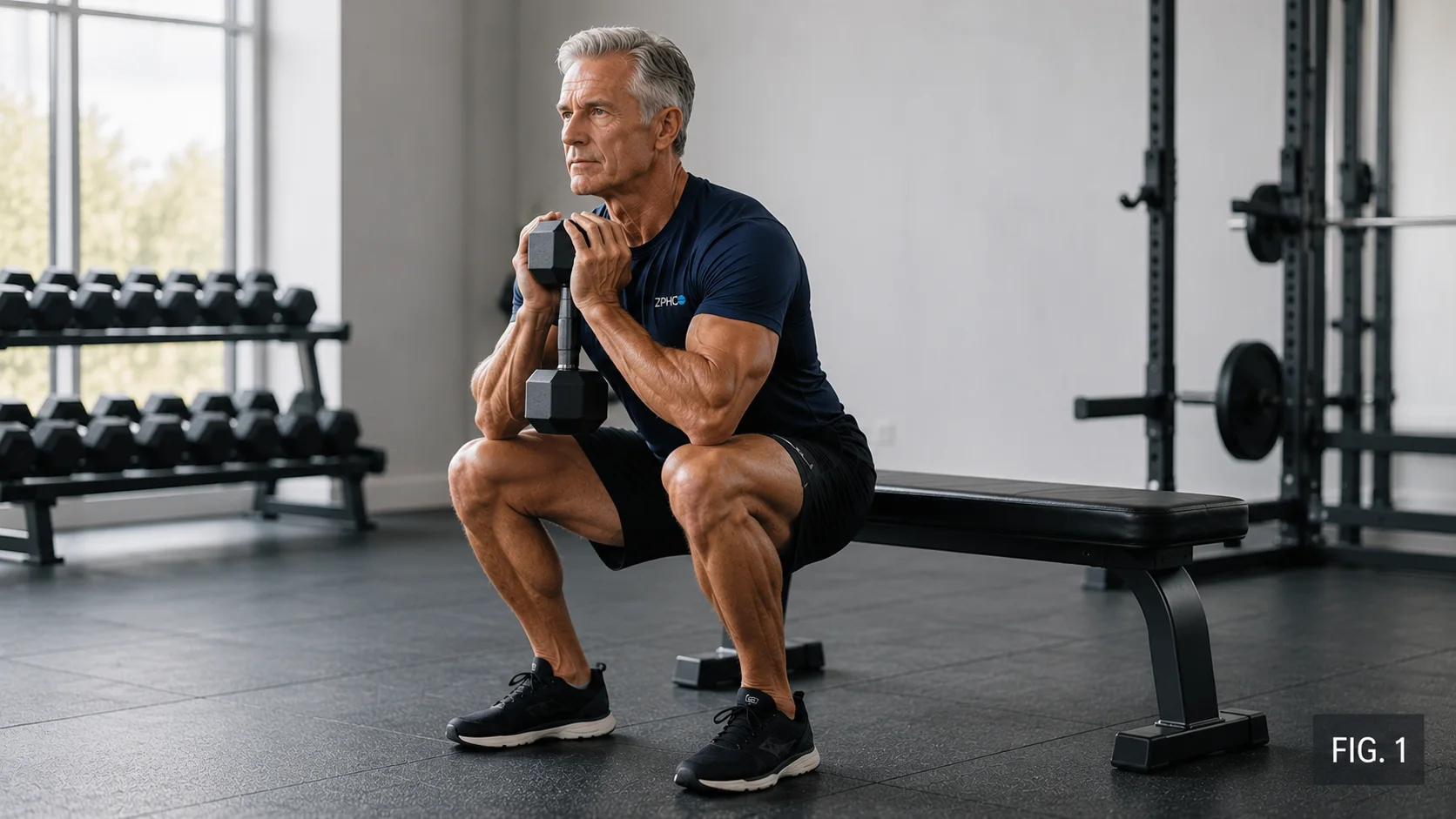
4.1 Squat and sit-to-stand
The squat pattern develops the thighs, hips and trunk while practising the act of lowering and raising the body.
This pattern appears every time a person:
- Sits into a chair.
- Rises from a toilet.
- Gets into a vehicle.
- Lowers toward the floor.
- Climbs out of a low seat.
- Absorbs force during a landing or step.
Appropriate starting variations
- Sit-to-stand from a high chair.
- Box squat.
- Supported squat while holding a fixed rail.
- Goblet squat to a bench.
- Belt squat.
- Leg press.
- Hack squat with an appropriate range.
Technical priorities
Feet should remain stable.
The knees should track naturally in the direction of the feet rather than collapsing uncontrollably inward.
The trunk should remain controlled.
The person should descend only as far as control and tolerance permit.
The bench in a box squat is a depth target, not a place to collapse. The athlete should touch it lightly or sit under control, maintain tension and stand without rocking.
Common errors
- Using a box that is too low.
- Dropping quickly onto the bench.
- Lifting the heels.
- Allowing the knees to collapse.
- Relaxing completely at the bottom.
- Using momentum to stand.
- Forcing depth that the person cannot control.
Progression options
- Reduce hand assistance.
- Add repetitions.
- Lower the box slightly.
- Slow the descent.
- Add a small amount of load.
- Move from bilateral to split-stance work.
4.2 Hip hinge
The hip hinge develops the posterior chain: glutes, hamstrings, spinal stabilizers and grip.
It is central to lifting objects from the floor or a low surface.
Appropriate variations
- Wall hip-hinge drill.
- Dowel-assisted hinge.
- Kettlebell deadlift from an elevated surface.
- Trap-bar deadlift with raised handles.
- Romanian deadlift.
- Cable pull-through.
- Machine hip extension.
Technical priorities
The hips move backward.
The knees remain slightly bent rather than turning the movement into a squat.
The load stays close to the body.
The trunk remains stable.
The movement stops when the person reaches the deepest controlled position, not when the weights reach an arbitrary height.
Common errors
- Reaching the weight away from the body.
- Rounding aggressively to create more depth.
- Bending the knees excessively.
- Hyperextending the lower back at the top.
- Turning each repetition into a fast bounce.
A shorter, controlled hinge is better than a deeper hinge built on compensation.
4.3 Upper-body push
Pushing movements develop the chest, shoulders and triceps.
They support tasks such as:
- Pushing a door.
- Rising with assistance from the arms.
- Moving furniture.
- Placing objects onto a shelf.
- Bracing against a surface.
Appropriate variations
- Wall push-up.
- Incline push-up.
- Machine chest press.
- Dumbbell floor press.
- Neutral-grip dumbbell bench press.
- Cable press.
- Landmine press.
- Supported overhead press.
Technical priorities
The shoulder blades should move naturally.
The wrist should remain reasonably aligned.
The pressing angle must match shoulder tolerance.
The movement should stop before the shoulders roll forward uncontrollably or pain escalates.
A floor push-up is not a required standard. Elevating the hands allows the same pattern to be scaled precisely.
4.4 Upper-body pull
Pulling movements develop the upper back, lats, rear shoulders, arms and grip.
They support posture under load, carrying, climbing and shoulder function.
Appropriate variations
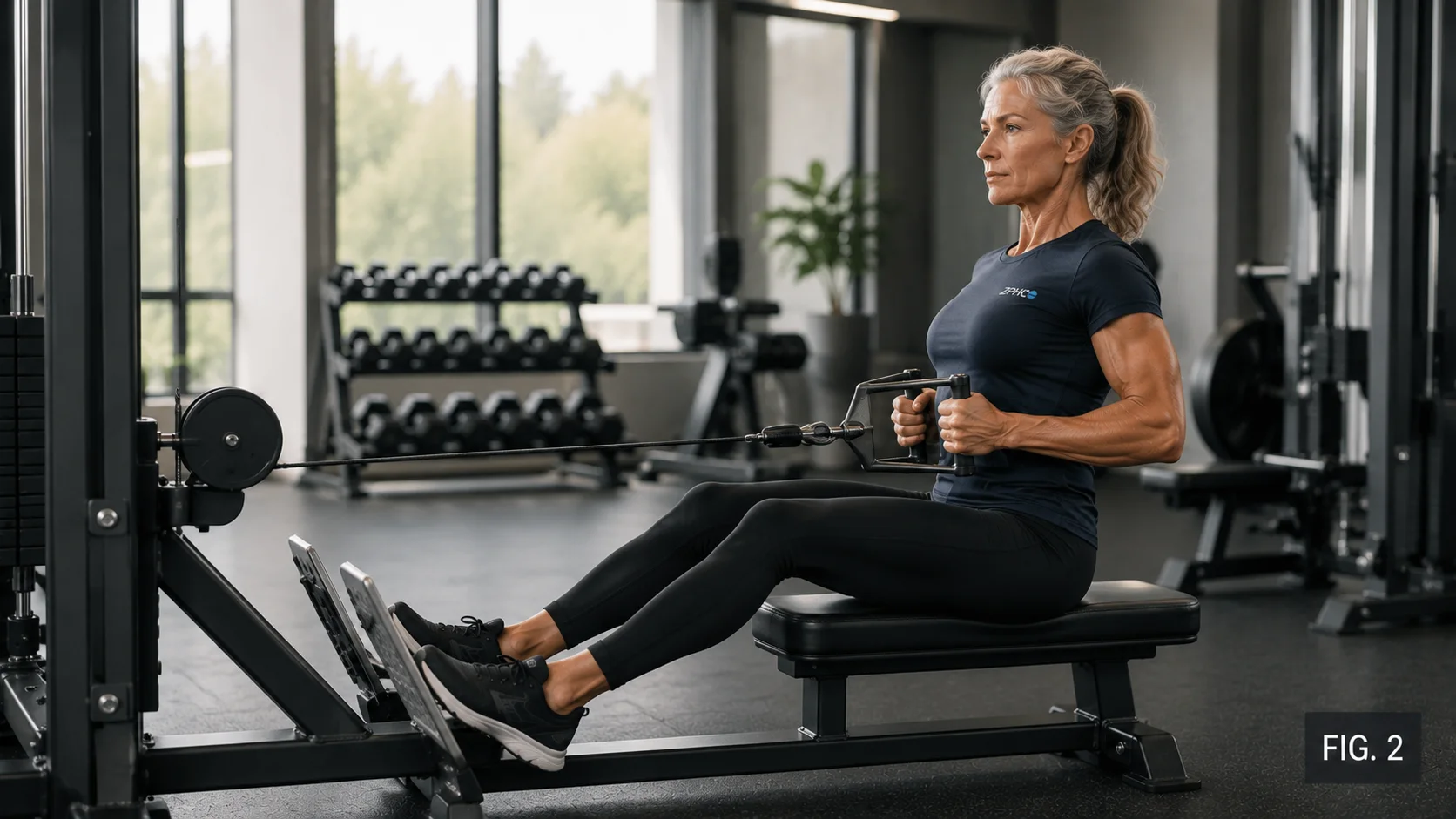
- Seated cable row.
- Chest-supported dumbbell row.
- Machine row.
- Resistance-band row with a verified anchor.
- Lat pulldown.
- Band pulldown.
- One-arm supported cable row.
Equipment logic matters
A cable exercise is only valid when the equipment is correctly configured.
The handle must be attached to a visible cable.
The cable must run through an appropriate pulley.
The machine or anchor must be stable.
The seat and foot supports must allow the athlete to create force without sliding.
A resistance band should be attached to an anchor capable of tolerating the load. Looping a band around an unstable chair, sharp edge or unidentified object is poor practice.
Technical priorities
The torso remains controlled.
The shoulders stay away from the ears.
The elbows move in a natural path.
The movement does not require violent backward leaning.
The athlete finishes the repetition when the back is fully engaged, not when the elbows are forced as far behind the body as possible.
4.5 Step-up and split-stance movement
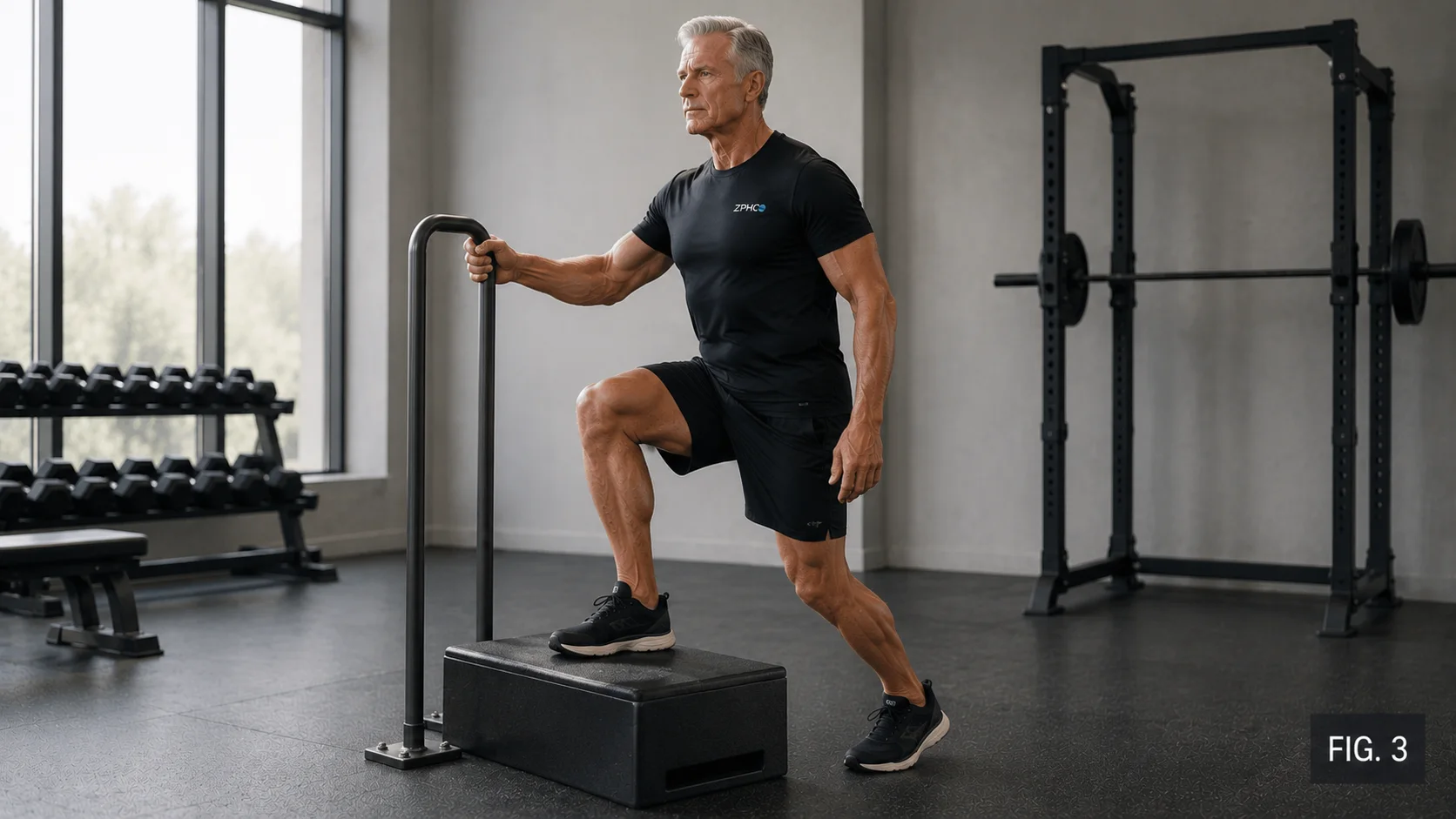
Step-ups and split squats develop single-leg strength and control.
They are particularly relevant to:
- Stairs.
- Curbs.
- Uneven terrain.
- Hiking.
- Entering high vehicles.
- Recovering from a staggered position.
Appropriate variations
- Low supported step-up.
- Step-up without support.
- Supported split squat.
- Static lunge with support.
- Reverse lunge.
- Rear-foot-elevated split squat for advanced trainees.
Technical priorities for a step-up
The full leading foot should be placed on the platform.
The athlete should drive primarily through the leading leg.
The knee should track over the foot.
The pelvis should remain controlled.
The platform should be stable and low enough to avoid pulling excessively with the trailing leg.
External support is not cheating. Light support can improve safety while allowing the target leg to work harder and more accurately.
4.6 Loaded carries
Carries are among the most transferable strength exercises.
They train:
- Grip.
- Trunk stability.
- Shoulder control.
- Gait under load.
- Posture.
- Breathing under moderate effort.
- Coordination.
Variations
- Farmer carry with a load in each hand.
- Suitcase carry with one load.
- Front carry with an object close to the torso.
- Offset carry with unequal loads.
- Marching in place when space is limited.
Technical priorities
The athlete should walk normally.
The shoulders remain level.
The load does not swing aggressively.
The person does not lean heavily away from the weight.
Breathing continues.
A short controlled carry is more useful than a long carry performed with deteriorating posture.
4.7 Trunk control
The trunk must do more than flex repeatedly.
Its primary training roles include:
- Resisting unwanted extension.
- Resisting rotation.
- Resisting lateral flexion.
- Transferring force between the upper and lower body.
- Maintaining position during carrying and lifting.
Appropriate exercises
- Dead bug.
- Bird dog.
- Pallof press.
- Side-plank variation.
- Suitcase carry.
- Front carry.
- Controlled cable rotation.
- Supported marching.
The objective is not maximal abdominal discomfort.
It is maintaining position while breathing and moving the limbs.
4.8 Calf and ankle function
Calf strength contributes to walking, stair climbing, balance and propulsion.
Ankle control also influences how effectively the body responds to changes in direction or terrain.
Appropriate exercises
- Supported standing calf raise.
- Seated calf raise.
- Toe raise against a wall.
- Slow heel-to-toe walking.
- Low step-down.
- Controlled ankle dorsiflexion work.
Calf training is not an optional bodybuilding detail. It is part of locomotion.
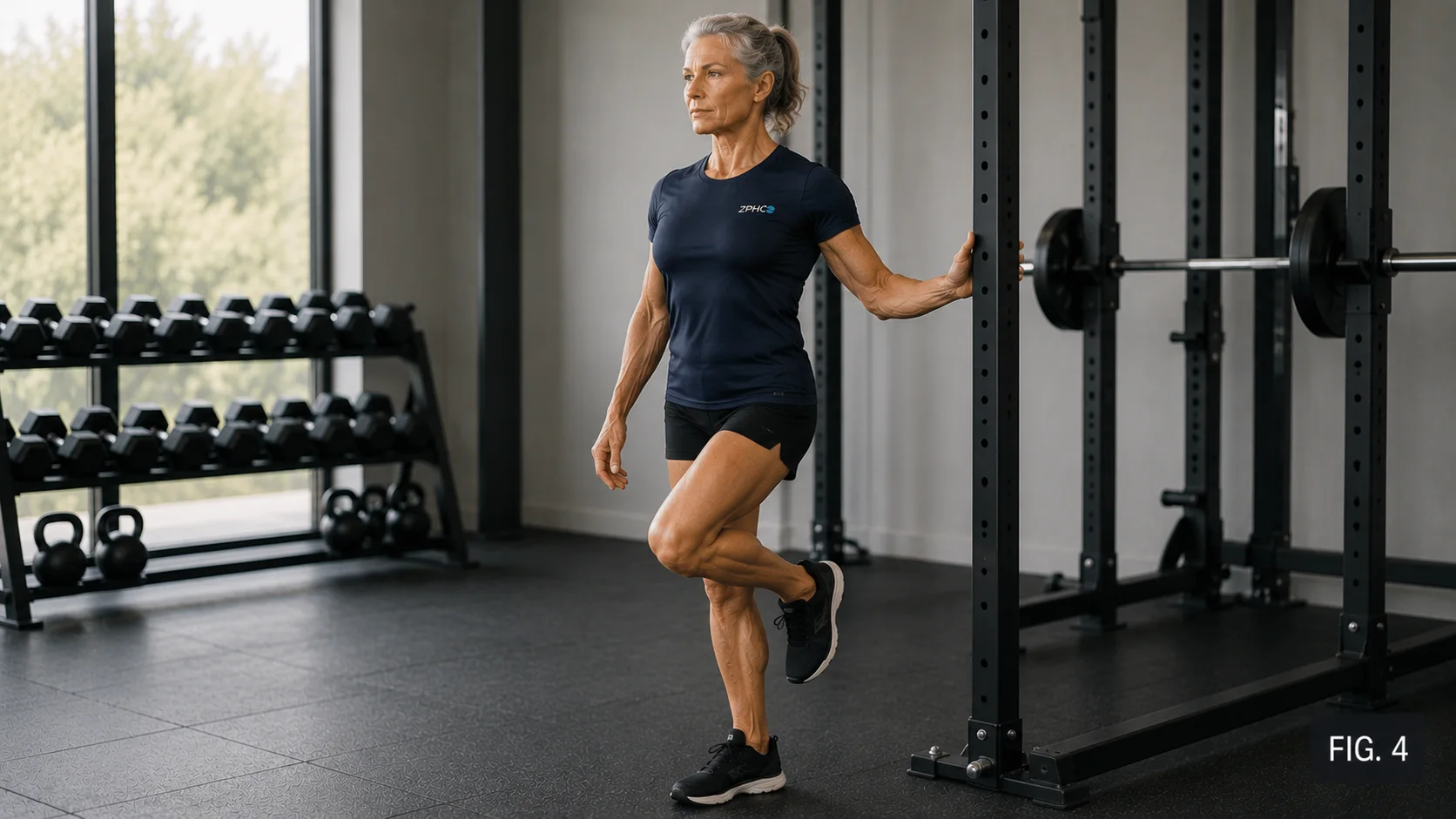
4.9 Balance
Balance should be trained deliberately.
It should not be reduced to standing on an unstable object while performing unrelated movements.
A safe progression may include:
- Feet together near support.
- Staggered stance.
- Heel-to-toe stance.
- Supported single-leg stance.
- Controlled step-and-hold.
- Slow head turns.
- Direction changes.
- Reactive stepping under qualified supervision.
The drill should create challenge without creating danger.
4.10 Power
Power is the ability to produce force quickly.
It contributes to:
- Rising rapidly.
- Accelerating while walking.
- Recovering from a trip.
- Moving onto a step.
- Responding to an unexpected load.
Power training should not be introduced recklessly.
A person first needs:
- Adequate technique.
- Stable balance.
- Basic strength.
- Appropriate joint tolerance.
- Control of the exercise.
Early power work may be as simple as:
- Standing from a chair with a controlled but purposeful upward phase.
- Performing a light leg press with faster concentric intent.
- Using a light medicine-ball chest pass.
- Completing a low step-up with deliberate acceleration.
The load should remain manageable, and the movement should stop when speed or control deteriorates. ACSM’s current position stand indicates that moderate-load power training can improve power and aspects of physical function.
Sets, repetitions, load and effort
Program design often becomes unnecessarily complicated.
The core variables are:
- Exercise selection.
- Frequency.
- Sets.
- Repetitions.
- Load.
- Effort.
- Rest.
- Range of motion.
- Movement speed.
- Weekly volume.
A practical starting framework
For many healthy beginners and returners:
| Variable | Practical starting range |
|---|---|
| Strength sessions | 2 full-body sessions weekly |
| Working sets | 1–3 per exercise |
| Repetitions | Usually 6–15 |
| Effort | Approximately 2–4 repetitions in reserve |
| Rest | Approximately 1–3 minutes |
| Exercises per session | Approximately 5–8 |
| Session duration | Approximately 40–65 minutes |
These are operating ranges, not laws.
A calf raise may use fifteen repetitions. A step-up may use six repetitions per leg. A carry may use time or distance rather than repetitions.
CDC guidance suggests working major muscle groups at least twice weekly, generally using 8–12 repetitions per activity, with at least one set and additional benefits possible from two or three sets.
Repetitions in reserve
Repetitions in reserve, or RIR, estimates how many technically acceptable repetitions remain at the end of a set.
Four RIR: approximately four more good repetitions were possible.
Two RIR: approximately two more were possible.
Zero RIR: no additional technically acceptable repetition was possible.
Most beginners do not need to train to zero RIR.
Leaving two to four repetitions in reserve allows meaningful effort without forcing every set into technique breakdown.
ACSM’s 2026 review found that training to momentary muscular failure did not consistently improve outcomes for the average healthy adult.
How to determine whether the weight is appropriate
The load is probably too light when:
- The planned set ends with minimal effort.
- Ten or more additional repetitions appear possible.
- The target muscles are barely challenged.
- The person must perform extremely high repetitions to create fatigue.
The load is probably too heavy when:
- Technique changes immediately.
- Balance becomes unreliable.
- Range collapses.
- The athlete cannot complete the minimum planned repetitions.
- Pain escalates.
- Breathing becomes uncontrolled.
- The set becomes a series of compensations.
A suitable load creates clear muscular effort while preserving the intended movement.
Heavier is not automatically better
Heavier loads are particularly useful when the primary objective is maximal strength. ACSM’s updated position stand found that heavier loads, multiple sets and training major muscle groups at least twice weekly can optimize strength development.
That does not mean a beginner should immediately train at 80% of one-repetition maximum.
Beginners can become stronger across a broad loading range. Early progress also comes from:
- Improved technique.
- Better coordination.
- Increased confidence.
- Greater range.
- Better control.
- Increased repetition capacity.
Heavier loading can be introduced when these foundations are established.
Rest periods
Strength training requires enough rest to maintain output.
A practical range is:
- Approximately one minute after small accessory exercises.
- Approximately ninety seconds to three minutes after demanding compound exercises.
- Longer when breathing, grip or balance requires it.
Older adults are not required to rush.
Turning every strength session into a cardiovascular circuit may reduce the quality of the resistance stimulus.
Tempo
Tempo refers to repetition speed.
A useful default is:
- Controlled lowering.
- Brief stable transition.
- Purposeful lifting.
- No uncontrolled bouncing.
The lowering phase does not need to take a theatrical five seconds. It should be slow enough that the athlete remains in control.
Power exercises are different. Their lifting phase may be deliberately faster, but only after the athlete has earned the right to move faster.
Range of motion
The most productive range is the largest range the athlete can currently control and tolerate.
That may be a full anatomical range.
It may also be a temporarily reduced range because of:
- Joint structure.
- Injury history.
- Mobility.
- pain.
- confidence.
- balance.
- equipment.
Reduced range is a programming tool, not a permanent identity.
Range may expand as strength and control improve.
Machines, free weights, bands and body weight
No equipment category is universally superior.
Machines offer:
- Stability.
- Predictable resistance.
- Easier setup.
- Reduced balance demand.
Free weights offer:
- Flexible movement paths.
- Loading options.
- Greater stabilization demand.
- Broad exercise variety.
Bands offer:
- Low cost.
- Portability.
- Home-training utility.
- Variable resistance.
Body-weight exercises offer:
- Accessibility.
- Low setup demands.
- Useful movement practice.
ACSM’s review found that equipment type did not consistently determine outcomes and that bands, body weight and home-based training can all be effective.
Breathing
Do not hold the breath for prolonged periods during routine training.
A practical default is:
- Inhale during the easier or lowering phase.
- Exhale through the demanding phase.
- Maintain trunk control without excessive straining.
Experienced lifters sometimes use specific bracing and breath-holding strategies under heavy loads. Those methods should not be copied casually by beginners, particularly when blood-pressure or cardiovascular concerns exist.
A complete two-day full-body program
Two full-body sessions per week are a strong default for people beginning or returning to resistance training.
They provide:
- Frequent practice.
- Manageable recovery.
- Coverage of all major movement patterns.
- Flexibility when one session is missed.
- Sufficient stimulus for early progress.
Leave at least one day between sessions.
The warm-up
A warm-up should prepare the session, not exhaust the athlete.
Stage 1: general movement
Perform five to eight minutes of easy walking, cycling or rowing.
The objective is to increase temperature and begin moving, not to create fatigue.
Stage 2: movement preparation
Practise simplified versions of the planned exercises.
For a box squat session:
- Body-weight sit-to-stand.
- Controlled ankle movement.
- Light goblet squat.
- One or two ramp-up sets.
For a cable-row session:
- Easy shoulder-blade movement.
- Light cable rows.
- Gradual increases in resistance.
Stage 3: ramp-up sets
Before the first demanding exercise, perform one to three lighter sets.
Example:
- Eight repetitions with a very light load.
- Five repetitions with a moderate warm-up load.
- Begin the working sets.
Warm-up volume should decrease as load increases.
Day A: squat, horizontal pull, horizontal push and carry
| Exercise | Sets and repetitions | Effort | Rest | Main objective |
|---|---|---|---|---|
| Box squat or leg press | 2–3 × 6–10 | 2–4 RIR | 2–3 min | Leg strength and sit-to-stand capacity |
| Seated cable or chest-supported row | 2–3 × 8–12 | 2–3 RIR | 90–150 sec | Upper-back and pulling strength |
| Incline push-up or machine chest press | 2–3 × 6–12 | 2–3 RIR | 90–150 sec | Chest, shoulder and triceps strength |
| Light Romanian deadlift | 2 × 8–10 | 3 RIR | 2 min | Hip-hinge practice |
| Farmer or suitcase carry | 2–4 × 20–40 sec | Controlled | 60–90 sec | Grip, gait and trunk control |
| Supported calf raise | 2–3 × 10–15 | 2–3 RIR | 60–90 sec | Calf and ankle strength |
| Supported single-leg balance | 2–3 × 15–30 sec per side | Controlled | As needed | Balance skill |
Box-squat standard
Select a bench height that allows control.
The final repetition should resemble the first.
When the athlete can perform all planned repetitions without collapsing onto the bench, losing foot pressure or experiencing an unacceptable next-day response, progression may be considered.
Row standard
The handle and cable should move through a logical path.
Stop the set when the athlete must lean farther backward, shrug or shorten the range significantly.
Carry standard
Use a distance that can be completed with normal gait.
The objective is not to survive the heaviest load possible. It is to carry while maintaining posture and breathing.
Day B: hinge, step, vertical pull and press
| Exercise | Sets and repetitions | Effort | Rest | Main objective |
|---|---|---|---|---|
| Elevated kettlebell deadlift or Romanian deadlift | 2–3 × 6–10 | 2–4 RIR | 2–3 min | Posterior-chain strength |
| Low step-up or supported split squat | 2–3 × 6–10 per side | 2–3 RIR | 90–150 sec | Single-leg strength and control |
| Lat pulldown or band pulldown | 2–3 × 8–12 | 2–3 RIR | 90–150 sec | Vertical pulling strength |
| Landmine or supported dumbbell press | 2–3 × 6–10 | 2–3 RIR | 90–150 sec | Shoulder and pressing strength |
| Pallof press or dead bug | 2–3 controlled sets | Controlled | 60–90 sec | Trunk control |
| Toe raise or controlled step-down | 2 × 10–15 | 2–3 RIR | 60–90 sec | Ankle and lower-leg function |
| Heel-to-toe walk or step-and-hold | 2–4 short rounds | Controlled | As needed | Dynamic balance |
A home-based version
A gym is not mandatory.
| Gym exercise | Home alternative |
|---|---|
| Box squat | Sit-to-stand from a stable chair |
| Cable row | Band row from a verified fixed anchor |
| Machine chest press | Wall or incline push-up |
| Romanian deadlift | Dumbbell, kettlebell or loaded-bag hinge |
| Step-up | Stable household step with fixed support |
| Lat pulldown | Anchored band pulldown |
| Farmer carry | Plain weighted bags or containers |
| Pallof press | Anchored resistance-band press |
Home equipment must be stable.
Do not use furniture that can tip, slide or break.
A thirty-minute minimum-effective session
When time or recovery is limited:
- Perform one squat or hinge.
- Perform one pull.
- Perform one push.
- Perform one carry or trunk exercise.
- Perform one balance drill.
Complete two quality sets of each.
A focused thirty-minute session is more productive than a perfect sixty-minute session that is repeatedly skipped.
How to progress for twelve weeks
Progression should be systematic.
Randomly adding weight because a session felt good is not systematic.
Changing exercises every week is not progression.
Training to exhaustion and hoping adaptation follows is not a plan.
Establish the baseline
During the first week, record:
- Exercise variation.
- Seat or box height.
- Load.
- Sets.
- Repetitions.
- Estimated RIR.
- Any support used.
- Symptoms during the exercise.
- Symptoms later that day.
- Next-morning response.
This baseline allows future decisions to be based on evidence rather than memory.
The double-progression method
Assume the programmed range is two sets of six to ten repetitions.
Begin with a load that allows:
- Set 1: seven repetitions.
- Set 2: six repetitions.
- Two or three repetitions left in reserve.
Over several sessions, progress toward:
- 8 and 7.
- 8 and 8.
- 9 and 8.
- 9 and 9.
- 10 and 10.
Once both sets reach ten with stable technique and acceptable recovery, increase the load by the smallest practical amount.
Repetitions may fall back to six or seven.
The cycle then begins again.
Variables that can be progressed
Progress is not limited to weight.
You may increase:
- Repetitions.
- Load.
- Sets.
- Range.
- Movement speed in selected exercises.
- Carry distance.
- Balance duration.
- Independence from hand support.
- Technical consistency.
A step-up performed with less hand pressure is progress.
A squat performed to a lower bench is progress.
A cable row performed with less torso movement is progress.
A carry completed with better posture is progress.
A twelve-week structure
Weeks 1–3: skill and tolerance
Primary objectives:
- Learn equipment setup.
- Establish controlled ranges.
- Practise breathing.
- Determine recoverable volume.
- Stop each set well before failure.
Most exercises should use one or two working sets.
Do not chase soreness.
Weeks 4–6: build repetition capacity
Primary objectives:
- Add repetitions within the planned range.
- Improve consistency between sets.
- Reduce unnecessary assistance.
- Maintain stable next-day recovery.
Add a third set only where recovery is clearly sufficient.
Weeks 7–9: increase resistance selectively
Primary objectives:
- Add small amounts of load.
- Maintain the same movement standards.
- Continue building range where appropriate.
- Avoid increasing every exercise simultaneously.
One or two exercises may progress in a session. The entire program does not need to change at once.
Weeks 10–11: consolidate and develop intent
Primary objectives:
- Retain the new loads.
- Improve repetition quality.
- Introduce faster lifting intent in selected safe exercises.
- Avoid major volume increases.
A suitable athlete may perform the upward phase of a light sit-to-stand or leg press with more purposeful speed while maintaining control.
Week 12: review or deload
Reduce total volume by approximately 25–40%, or maintain volume with lighter loads.
Review:
- Strength improvement.
- Functional improvement.
- Joint response.
- Balance.
- Sleep.
- Motivation.
- Adherence.
- Exercise suitability.
The objective is to finish the block capable of beginning another one.
Microloading
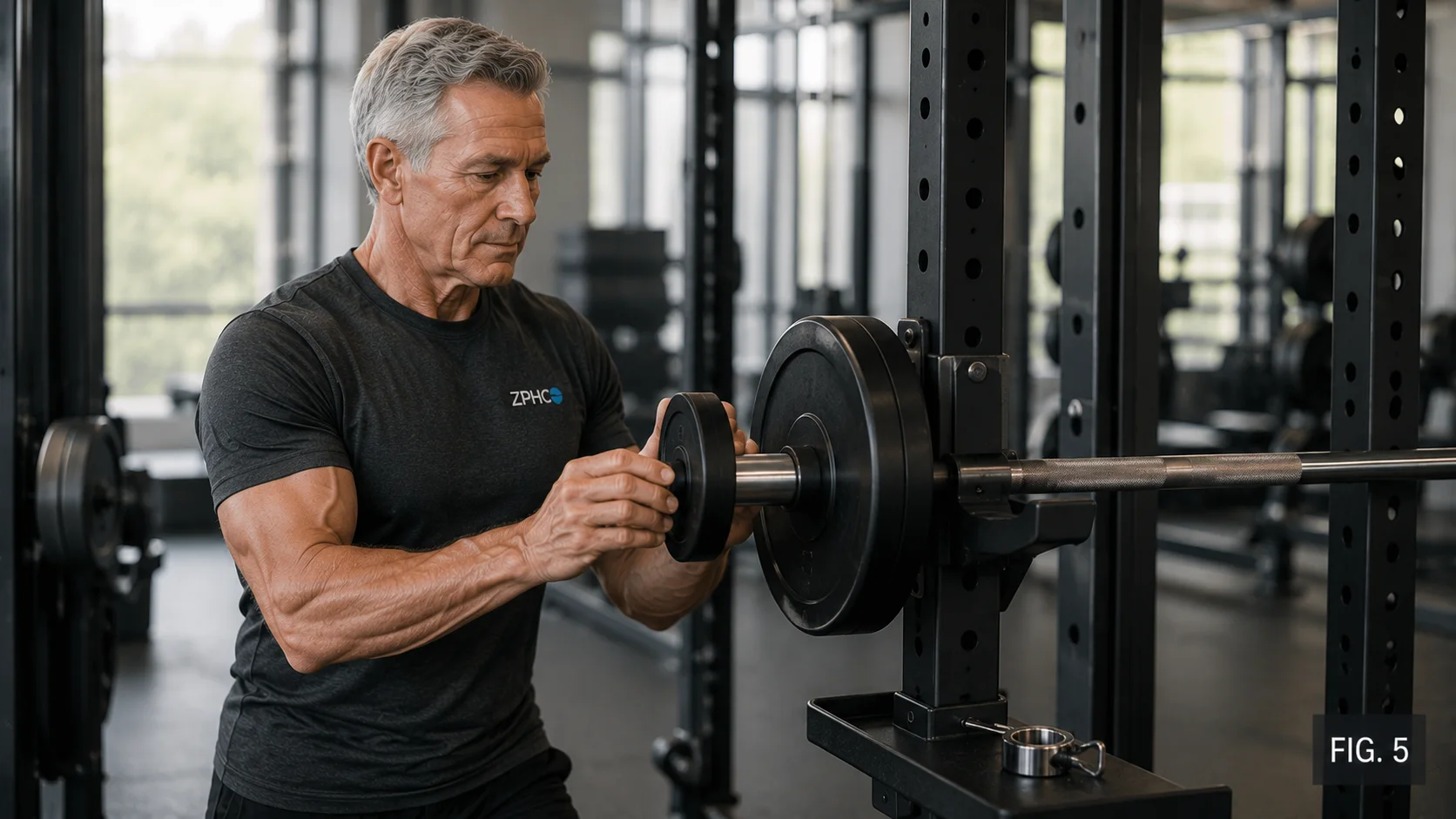
Large jumps are often unnecessary.
Adding one or two kilograms may represent a substantial percentage increase for smaller upper-body exercises.
Use:
- Microplates.
- Small weight-stack increments.
- Additional repetitions.
- Slight range increases.
- Slower lowering phases.
When to hold or reduce the load
Do not progress when:
- Technique is deteriorating.
- Joint irritation is accumulating.
- Sleep has worsened.
- Performance has fallen for several sessions.
- Normal daily activity is being reduced because of training fatigue.
- Soreness regularly lasts several days.
- Motivation has collapsed.
- Illness or major life stress has reduced recovery capacity.
Holding a load is not failure.
Maintaining performance during a difficult period may be a legitimate success.
The CLUB ZPHC® Training Volume Calculator can be used as an educational checkpoint when weekly hard-set volume and recovery begin to diverge.
Balance and power require dedicated attention
Balance is a trainable skill
Balance depends on several systems:
- Vision.
- Inner-ear function.
- Sensory information from the feet and joints.
- Strength.
- Reaction speed.
- Coordination.
- Confidence.
- Attention.
Because balance is multifactorial, simply standing on one leg occasionally is not a complete strategy.
A balance progression ladder
Level 1: stable stance
- Feet together.
- Staggered stance.
- Heel-to-toe stance.
Use a fixed support nearby.
Level 2: reduced hand assistance
Move from full hand support to fingertip contact.
Do not remove support before the position is stable.
Level 3: single-leg control
Lift one foot slightly.
Keep the pelvis level.
Use short holds.
Level 4: controlled movement
- Step and hold.
- Slow marching.
- Controlled direction changes.
- Low step-over.
Level 5: cognitive or visual challenge
Only after basic control is reliable:
- Slow head turns.
- Carrying a light object.
- Following simple directional instructions.
- Changing walking speed.
Closing the eyes should not be treated as a default progression. It removes a major sensory input and can create unnecessary risk.
Perform balance work before severe fatigue
Balance practice requires concentration and coordination.
It is often better placed:
- Early in the session after warming up.
- Between non-fatiguing exercises.
- In a separate short practice.
- At home near a fixed support.
Performing difficult balance exercises after exhausting leg work may reduce quality.
Power should be introduced gradually
Power work does not need to look explosive or dangerous.
The earliest stage is often intent.
The athlete lowers under control and then tries to stand or press with purposeful speed.
Suitable entry points may include:
- Fast-intent sit-to-stand.
- Light machine press with purposeful acceleration.
- Low step-up with deliberate drive.
- Light medicine-ball pass.
- Controlled sled push.
The load must remain manageable.
Stop the set when movement speed clearly declines.
Integrating cardiovascular exercise
Resistance training does not replace aerobic exercise.
Aerobic exercise supports:
- Cardiovascular capacity.
- Work tolerance.
- Recovery between sets.
- Walking endurance.
- Metabolic health.
- Participation in recreational activity.
Current guidance recommends at least 150 minutes of moderate-intensity aerobic activity weekly, or an appropriate vigorous equivalent.
Use the talk test
During moderate-intensity exercise, a person should generally be able to speak in sentences but not sing comfortably.
During vigorous activity, speaking more than a few words becomes difficult.
Heart-rate targets may be misleading for people taking medications that affect heart rate. Relative effort and professional guidance may be more useful in those cases.
Start with tolerable doses
A beginner might use:
- Ten minutes of walking after meals.
- Fifteen-minute cycling sessions.
- Short swimming sessions.
- Several brief activity periods rather than one long workout.
Duration can be accumulated over the week.
Keep hard aerobic work away from demanding leg sessions when necessary
Experienced trainees may combine multiple training modes successfully.
Beginners often recover better when demanding lower-body strength and vigorous aerobic work are not stacked together repeatedly.
A simple approach is:
- Strength on Monday and Thursday.
- Moderate aerobic work on Tuesday, Friday and Saturday.
- Light walking on other days.
Reduce uninterrupted sitting
A person can complete two gym sessions and still remain highly sedentary for most of the week.
Break up long sitting periods with:
- Short walks.
- Standing tasks.
- Stairs.
- Light mobility.
- Brief household activity.
The gym should increase capacity for life, not become the only place where movement occurs.
Joint-friendly training and common health conditions
Joint-friendly training is not easy training.
It is training in which the stimulus is productive and unnecessary irritation is removed.
The CLUB ZPHC® Joint-Friendly Training Guide emphasizes controlled range, appropriate exercise selection, gradual progression and consistency before intensity.
Modify variables before abandoning a pattern
When an exercise causes irritation, consider changing:
- Range.
- Load.
- Grip.
- Stance.
- Tempo.
- Equipment.
- Support.
- Exercise order.
- Weekly frequency.
- Total sets.
Examples:
- Deep squat → higher box squat.
- Floor push-up → incline push-up.
- Bent-over row → chest-supported row.
- Straight-bar press → neutral-grip dumbbell press.
- Conventional deadlift → elevated kettlebell deadlift.
- Unsupported lunge → supported split squat.
- Overhead press → landmine press.
These are not inferior exercises.
They are better-matched tools.
Arthritis
Regular physical activity can improve pain, function and quality of life in many people with arthritis. Both aerobic and muscle-strengthening activity can contribute.
Programming may require:
- Longer warm-ups.
- Stable exercise variations.
- Reduced range during symptom flares.
- Lower initial volume.
- Slower progression.
- Different exercises on different days.
Do not assume that every joint sensation is harmful.
Do not force a movement that repeatedly produces escalating symptoms.
Osteoporosis
People with osteoporosis may benefit from weight-bearing, resistance and balance activity, but exercise selection should account for fracture history, spinal changes and fall risk. NIA advises people with osteoporosis to discuss appropriate physical activity with a healthcare provider.
A generic internet program is not sufficient for someone with:
- Recent fragility fracture.
- Significant vertebral compression.
- Severe balance impairment.
- High fall risk.
- Unexplained bone pain.
High blood pressure
Both aerobic and muscle-strengthening exercise can be useful in managing blood pressure.
Practical precautions include:
- Avoiding unnecessary maximal strain.
- Avoiding prolonged breath-holding.
- Building intensity gradually.
- Allowing adequate rest.
- Monitoring unusual dizziness or headaches.
- Coordinating with a clinician when blood pressure is uncontrolled or medication has recently changed.
Diabetes
Exercise can improve blood-glucose management and cardiovascular health in adults with type 2 diabetes.
People using insulin or medication that can produce hypoglycaemia may require a specific plan involving:
- Glucose monitoring.
- Food timing.
- Medication timing.
- Foot care.
- Appropriate footwear.
- Recognition of hypoglycaemia symptoms.
This should be coordinated with the healthcare team.
Chronic pain
Inactivity can contribute to loss of function, but aggressively forcing pain is not a sophisticated alternative.
A better strategy may include:
- Predictable exercise selection.
- Lower initial volume.
- Stable ranges.
- Gradual exposure.
- Symptom monitoring.
- Coordination with a clinician or rehabilitation professional.
Avoid overtraining on unusually good days and then requiring several days to recover.
Medication and balance
Some medications can influence:
- Blood pressure.
- Heart rate.
- Alertness.
- Coordination.
- Blood glucose.
- Hydration.
- Dizziness.
Medication should not be changed based on a fitness article.
The training plan may need to be adjusted around its effects.
Recovery and nutrition make the program work
Training creates a stimulus.
Adaptation requires resources.
Those resources include:
- Sleep.
- Adequate energy.
- Protein.
- Carbohydrate.
- Dietary fat.
- Hydration.
- Time between demanding sessions.
- Manageable life stress.
Sleep
CDC guidance lists approximately seven to eight hours as the general daily recommendation for adults aged 65 and older. Individual sleep needs and medical circumstances vary.
Poor sleep can affect:
- Coordination.
- Reaction time.
- Motivation.
- Perceived effort.
- Appetite.
- Recovery.
- Training quality.
A serious training program should not repeatedly require an exhausted person to perform technically demanding exercises.
The CLUB ZPHC® Recovery and Sleep Guide treats sleep, deloading, hydration and stress control as components of one recovery system.
Protein
Protein supports muscle maintenance and adaptation, but it cannot replace resistance training.
The PROT-AGE Study Group proposed approximately 1.0–1.2 grams of protein per kilogram of body weight daily for many healthy older adults, with different or higher requirements potentially applicable in illness, malnutrition or clinical circumstances under professional supervision.
Examples:
| Body weight | 1.0 g/kg | 1.2 g/kg |
|---|---|---|
| 60 kg | 60 g | 72 g |
| 70 kg | 70 g | 84 g |
| 80 kg | 80 g | 96 g |
| 90 kg | 90 g | 108 g |
These figures are not individualized prescriptions.
Needs may change with:
- Training volume.
- Energy intake.
- Illness.
- Kidney or liver disease.
- Appetite.
- Body composition.
- Weight-loss goals.
- Medical treatment.
The CLUB ZPHC® Protein Intake Guide discusses protein targets, meal distribution, aging and kidney-safety boundaries in greater detail.
Distribute protein across meals
Many adults eat little protein at breakfast, a moderate amount at lunch and most of their daily total at dinner.
A more balanced structure may make the target easier to reach.
A practical meal may contain approximately 20–40 grams of protein, depending on body size and total daily requirements. Another useful framework is approximately 0.3–0.4 g/kg per meal.
For an 80-kilogram adult, 0.3–0.4 g/kg would be approximately 24–32 grams per meal.
Possible foods include:
- Eggs.
- Greek-style yogurt.
- Cottage cheese.
- Fish.
- Poultry.
- Lean meat.
- Milk.
- Soy milk.
- Tofu.
- Tempeh.
- Beans.
- Lentils.
- Peas.
- Appropriate protein supplements.
The meal should still contain vegetables, fibre-rich foods, carbohydrates and dietary fats appropriate to the individual.
Energy intake
Muscle building becomes difficult when energy intake is chronically inadequate.
Older adults may unintentionally undereat because of:
- Reduced appetite.
- Dental problems.
- Swallowing difficulty.
- Medication effects.
- Social isolation.
- Cost.
- Digestive symptoms.
- Aggressive weight-loss dieting.
A person can consume adequate protein on paper but still recover poorly because total food intake is insufficient.
Carbohydrate
Carbohydrate supports training performance and recovery.
Useful sources may include:
- Potatoes.
- Rice.
- Oats.
- Whole grains.
- Fruit.
- Beans.
- Lentils.
- Dairy foods.
There is no need to fear carbohydrate simply because the article concerns active aging.
The relevant question is whether the overall diet supports health, training and body-composition goals.
Hydration
Hydration requirements vary with:
- Climate.
- Exercise duration.
- Body size.
- Medication.
- Sweat rate.
- Diet.
- Medical conditions.
Do not force arbitrary fluid volumes.
People with medically prescribed fluid restrictions should follow their clinical plan.
Creatine
Creatine monohydrate may enhance some gains in lean tissue and strength when combined with resistance training in aging adults. It is an adjunct, not a substitute for training.
A commonly used maintenance approach is approximately three to five grams daily. Loading is not required for most recreational users.
Creatine is not mandatory.
It should be considered only after the foundations are operating:
- Consistent training.
- Adequate protein.
- Adequate food.
- Sleep.
- Hydration.
- Appropriate health screening.
People with kidney disease, abnormal renal markers, complex medication use or significant chronic disease should obtain professional guidance.
The CLUB ZPHC® Creatine Monohydrate Guide provides a fuller discussion of dosing, side effects, older-adult use and clean-sport considerations.
Clean-sport considerations
Competitive and drug-tested athletes should not assume that a supplement is safe because its label appears simple.
USADA advises athletes who choose to use supplements to select appropriately third-party-certified products to reduce—though not eliminate—contamination and anti-doping risk.
No supplement certification removes strict-liability obligations.
Measure outcomes that matter
Body weight is not a complete performance metric.
Appearance is not a complete health metric.
A useful active-aging program tracks both gym performance and real-world function.
Training measures
Record:
- Load.
- Repetitions.
- Sets.
- RIR.
- Range.
- Support used.
- Carry distance.
- Balance duration.
- Rest required.
- Session duration.
Functional measures
Useful indicators include:
- Ease of standing from a chair.
- Stair confidence.
- Walking speed.
- Ability to carry groceries.
- Ease of getting off the floor.
- Grip confidence.
- Ability to lift luggage.
- Recovery after recreational activity.
- Confidence on uneven ground.
Recovery measures
Monitor:
- Sleep quality.
- Soreness.
- Joint symptoms.
- Energy.
- Motivation.
- Appetite.
- Next-day movement.
- Performance trend.
The four-week review
Every four weeks, ask:
- Is strength improving?
- Is technique improving?
- Are ordinary tasks becoming easier?
- Is joint irritation stable or decreasing?
- Is the program being completed consistently?
- Is recovery acceptable?
- Does any exercise repeatedly create problems?
- Is the plan still compatible with normal life?
A program that looks impressive but cannot be sustained is not effective.
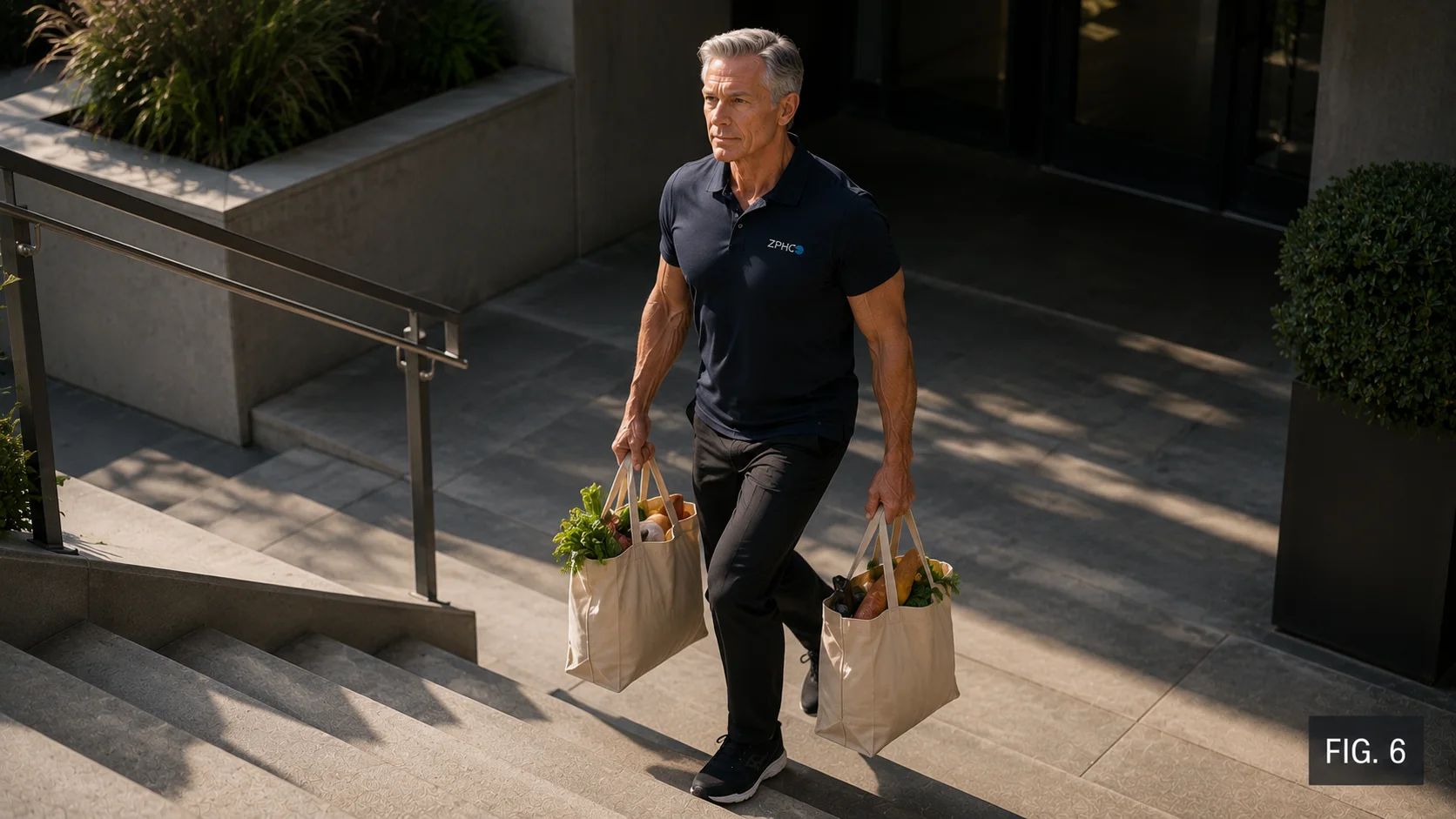
Daily life is the final performance test
The purpose of training is not to become permanently occupied by training.
The purpose is to increase capability outside the gym.
Common mistakes and myths
Myth 1: “I am too old to build strength”
Age influences adaptation, but it does not eliminate it.
Resistance training improves strength and physical function across adulthood. The program must match present ability, but low expectations should not be mistaken for safety.
Myth 2: “Walking is enough”
Walking is valuable aerobic activity.
It does not reliably provide progressive resistance for every major muscle group.
A complete plan includes walking or other aerobic activity, strength work and balance practice.
Myth 3: “Machines do not count”
Muscle responds to tension, effort and progression.
Machines can be particularly useful when stability, balance or exercise complexity would otherwise limit muscular effort.
Free weights are not automatically superior.
Myth 4: “Light weights are always safer”
A light weight performed through uncontrolled repetitions under severe fatigue is not necessarily safe.
A moderately challenging load performed with stable technique may be more appropriate.
Safety depends on:
- Exercise selection.
- Range.
- Load.
- Sets.
- Repetitions.
- Fatigue.
- Health status.
- Recovery.
Myth 5: “Older adults should never train hard”
Older adults can train hard.
The problem is not effort. The problem is unmanaged effort.
Hard training becomes productive when:
- Technique is stable.
- Exercise selection is appropriate.
- Recovery is sufficient.
- Progression is gradual.
- Medical risks are addressed.
Myth 6: “Every set must reach failure”
Failure is not required for most general strength and muscle-building outcomes.
Stopping with one to three technically sound repetitions remaining can provide a strong stimulus with less technique breakdown.
Myth 7: “Soreness proves the workout worked”
Soreness reflects novelty and tissue stress.
It does not measure program quality.
A productive session improves capacity without repeatedly interfering with normal movement.
Myth 8: “Pain always means damage”
Pain is complex.
Some discomfort may occur during new or rebuilding activity. Severe, escalating, spreading or neurologically associated pain requires a different response.
The correct approach is neither panic nor denial.
Myth 9: “A good program must change constantly”
Frequent exercise changes make progression difficult to measure.
Keep core movements long enough to learn them and document improvement.
Variation should solve a problem, not provide entertainment at the expense of consistency.
Myth 10: “Supplements are the advanced part”
Supplements are usually the least important part.
The advanced part is executing basic training, food and recovery consistently for years.
Frequently asked questions
How often should older adults strength train?
At least two days per week is the standard baseline. Two full-body sessions are a practical starting structure. Experienced lifters may train more frequently when volume and recovery are managed appropriately.
Can someone build muscle after 60 or 70?
Yes. The magnitude and speed of adaptation vary, but resistance training can improve strength, muscle and physical function in older adults.
How long should a session last?
Approximately forty to sixty-five minutes is sufficient for many full-body programs. A focused thirty-minute session can also be effective.
How many exercises are required?
Five to eight well-selected exercises can cover the major movement patterns.
More exercises do not automatically produce better results.
How heavy should the weights be?
Use a load that creates meaningful effort while preserving technique, balance and control. Most beginners should finish sets with approximately two to four technically acceptable repetitions remaining.
Should older adults use barbells?
Barbells are optional.
They can be effective for experienced trainees, but machines, dumbbells, cables, bands and body weight are also legitimate.
Are deep squats dangerous?
Depth is not automatically dangerous.
The appropriate depth depends on anatomy, mobility, control, pain, load and training history.
Use the deepest range that can be controlled and tolerated.
Should balance exercises be performed every day?
Brief, safe balance practice can be performed frequently. The difficulty should remain appropriate, and reliable support should be available.
Is a personal trainer required?
Not always.
Qualified coaching is particularly useful when the person has:
- Significant medical conditions.
- Poor balance.
- Low equipment confidence.
- Persistent pain.
- Complex injury history.
- Advanced performance goals.
The trainer should understand active aging and remain within professional scope.
What should happen when an exercise hurts?
Stop the set and identify which variable can be changed:
- Range.
- Load.
- Grip.
- Stance.
- Tempo.
- Support.
- Exercise variation.
Seek assessment when symptoms are severe, persistent, worsening, neurological or associated with trauma.
When should weight be increased?
Increase load after the current resistance can be completed at the top of the planned repetition range with stable technique and acceptable recovery.
Use the smallest practical increase.
Is creatine necessary?
No.
Creatine may support resistance-training outcomes, but it cannot replace training, protein, sleep or adequate food.
How quickly should results appear?
Some neural and technical improvements may be noticed within several weeks. More visible changes in muscle and substantial long-term functional improvements require months of consistent training.
Do not judge the program from one week.
What if energy is poor on a training day?
Adjust the dose.
Possible modifications include:
- Reduce one set.
- Use slightly less load.
- Perform only the main movements.
- Extend rest periods.
- Move the session.
- Replace it with easy walking and balance practice.
One adjusted session does not destroy progress.
Should older adults perform power training?
Power training may be valuable after adequate strength, technique and balance are established. It should begin with light or moderate resistance, controlled exercise selection and qualified guidance where needed.
Final takeaway
The objective is not to deny age.
The objective is to avoid surrendering physical capacity unnecessarily.
Train the legs so chairs, stairs and uneven ground remain manageable.
Train the hips and trunk so lifting remains controlled.
Train the upper body so pushing, pulling and carrying remain ordinary.
Train balance before instability becomes a crisis.
Develop power so the body can respond quickly when life does not move slowly.
Walk, cycle, swim or perform another form of aerobic activity because muscular strength is not the entire health system.
Eat enough complete food.
Distribute protein sensibly.
Sleep as if recovery matters—because it does.
Progress in small, measurable increments.
Do not chase exhaustion. Chase capability.
Strength training for older adults is not a softer category of fitness. It is the long-term management of muscle, force, balance and independence.
The gym is the preparation environment.
Life is the performance environment.
Train so that carrying your own life continues to feel normal.
External references
- American College of Sports Medicine. The Future of Fitness: ACSM Announces Top Trends for 2026
- American College of Sports Medicine. ACSM resistance-training guideline update coverage
- Currier BS, D’Souza AC, Fiatarone Singh MA, et al. Resistance Training Prescription for Muscle Function, Hypertrophy, and Physical Performance in Healthy Adults: An Overview of Reviews
- Centers for Disease Control and Prevention. Older Adult Activity: An Overview
- Centers for Disease Control and Prevention. What Counts as Physical Activity for Older Adults
- World Health Organization. WHO Guidelines on Physical Activity and Sedentary Behaviour
- National Institute on Aging. Exercising With Chronic Conditions
- National Institute on Aging. How Can Strength Training Build Healthier Bodies as We Age?
- Bauer J, Biolo G, Cederholm T, et al. Evidence-Based Recommendations for Optimal Dietary Protein Intake in Older People: A Position Paper From the PROT-AGE Study Group
- Deutz NEP, Bauer JM, Barazzoni R, et al. Protein Intake and Exercise for Optimal Muscle Function With Aging
- Tian H, et al. Comparison of Protein Supplementation, Resistance Training, and Their Combination in Older Adults
- Forbes SC, Candow DG, Krentz JR, Roberts MD, Young KC. Meta-Analysis Examining Creatine Supplementation and Resistance Training in Aging Adults
- Chilibeck PD, Kaviani M, Candow DG, Zello GA. Effect of Creatine Supplementation During Resistance Training on Lean Tissue Mass and Muscular Strength in Older Adults
- Centers for Disease Control and Prevention. About Sleep
- U.S. Anti-Doping Agency. Supplement Connect
Editorial policy: CLUB ZPHC® Editorial Standards
Sources and review notes
Sources last checked: June 21, 2026.
Corrections and updates
CLUB ZPHC® may update educational pages when sources, guidance, terminology, safety notes or internal editorial standards change. To report a possible correction, use the official contact form and include the article URL and exact issue.